TALOS CORE alarm handler
Every alarm, on every radio and every phone.
TALOS CORE is the full alarm handler, with no limit on the number of alarms. It runs on a PC on the ship's network and does everything TALOS EDGE does — alarms on the crew's TETRA radios as call-outs they accept, escalation until someone does, a record of every alarm — and adds the ship's phones, and inputs from Modbus, OPC, SNMP and webhooks.
No Limit on the Number of Alarms
TALOS EDGE is built for a vessel with a limited number of alarms. TALOS CORE has no such limit: it handles as many alarms as the vessel's systems raise, from every input, so it suits a large yacht or a ship with machinery, safety and guest systems all reporting to the crew.
The Ship's Phones, Beside the Radios
TALOS CORE connects to the ship's own phone system over SIP. An alarm can ring a phone and speak the alarm aloud, or send it as a text, at the same moment it goes to the radios.
Pressing 1 on the phone accepts it; star repeats it. A desk phone can carry a single ACCEPT key. The first acceptance from either side — a radio or a phone — ends the alarm on both, and records who accepted it.
An answered phone is never taken as an acceptance. Voicemail or a handset knocked off its cradle can answer a call; only a deliberate press counts.
More of the Vessel's Systems as Inputs
TALOS CORE reads Modbus TCP and RTU devices. Alongside serial RS-232 and RS-485 lines and network text feeds, it reads alarm points from OPC UA and OPC DA servers, receives SNMP traps from network equipment, and takes alarms posted to it as webhooks.
Reading rules work across them, turning a measured value into an alarm and reporting a value that goes quiet or never arrives. Wi-Fi crew call buttons raise their calls on it directly.
Where a system speaks its own language, OLAS builds a bespoke alarm listener for it, so its alarms reach the crew like any other.
Where Every Crew Member Is
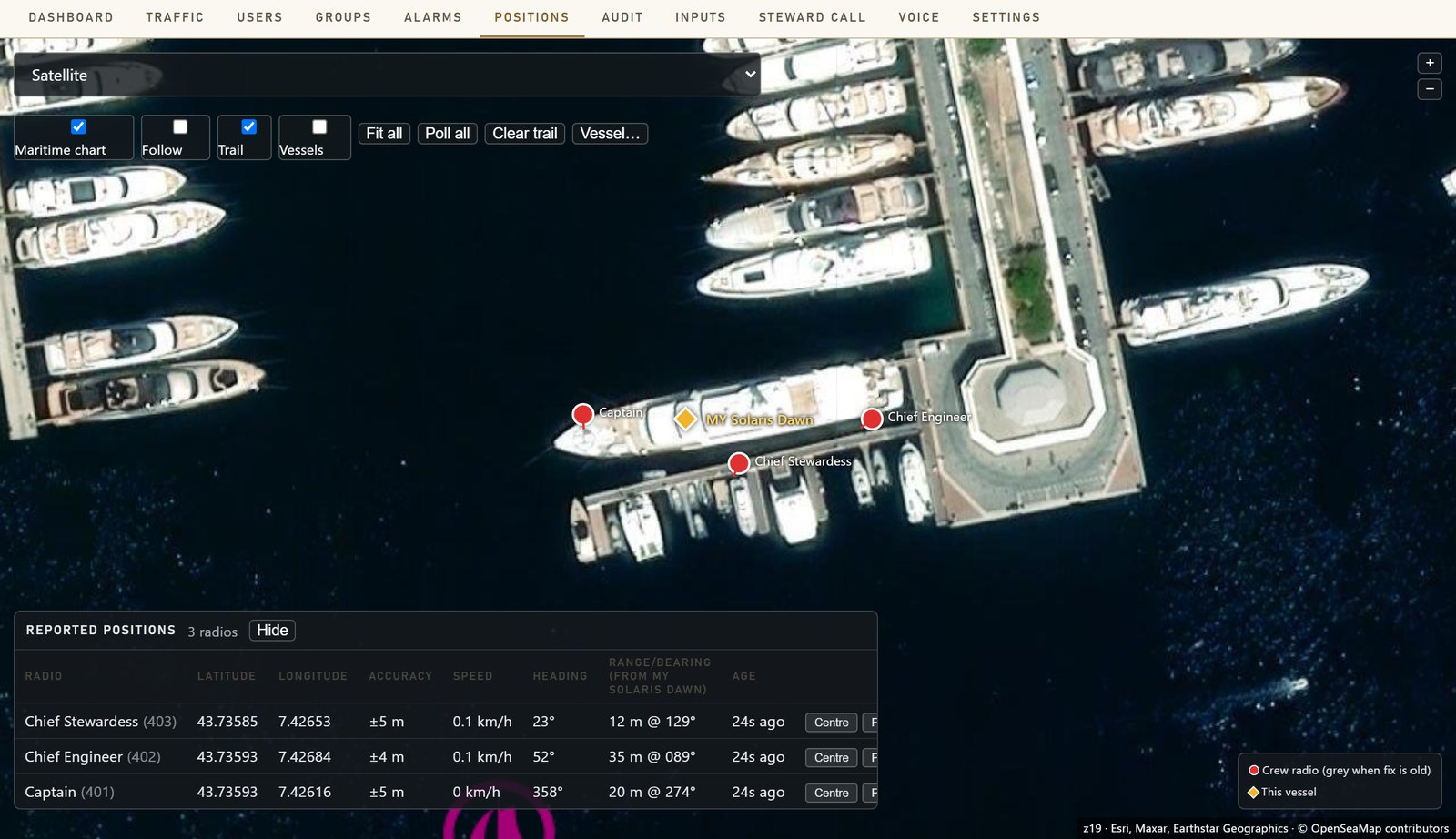
Radios that report their GPS position appear on a live map, on satellite imagery or a nautical chart, with a trail of where each has been and its range and bearing from the vessel.
Escalation Across Radios and Phones
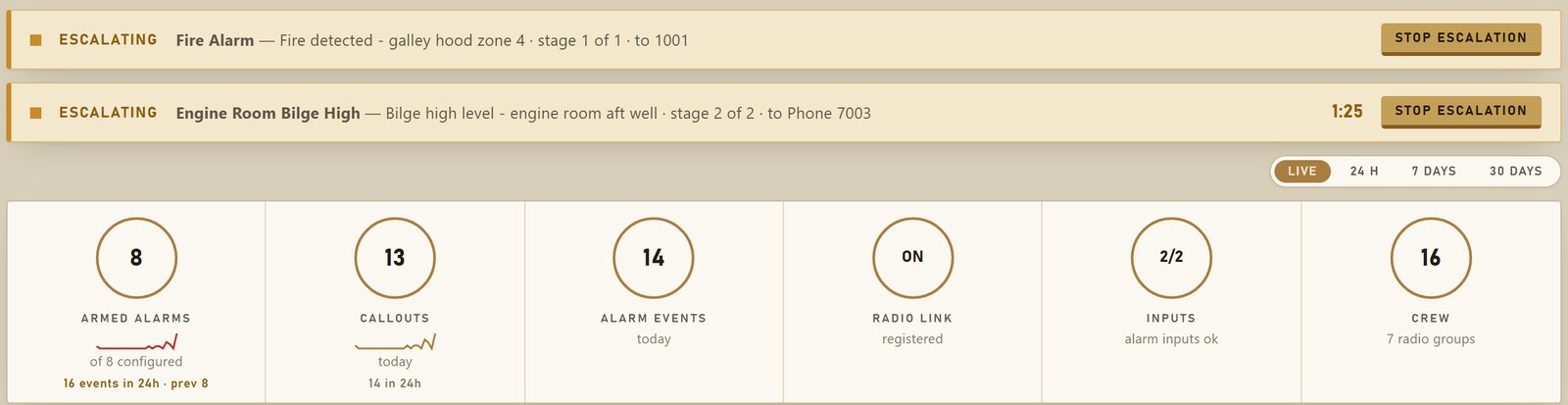
Each alarm's escalation can move between radios and phones — a crew member's radio, then the engineer's cabin phone, then a whole talkgroup — and keeps going until someone accepts.
Always Running
TALOS CORE runs as a Windows service: it starts with the PC and restarts itself after a failure, with no one logged in. If the radio link drops, alarms are held and sent when it returns, and the system reports its own faults to a radio and a phone rather than failing silently.
Where the vessel needs redundancy, TALOS CORE can run on a replicating virtual machine cluster, so alarm handling carries on if a host fails.
A Record of Everything
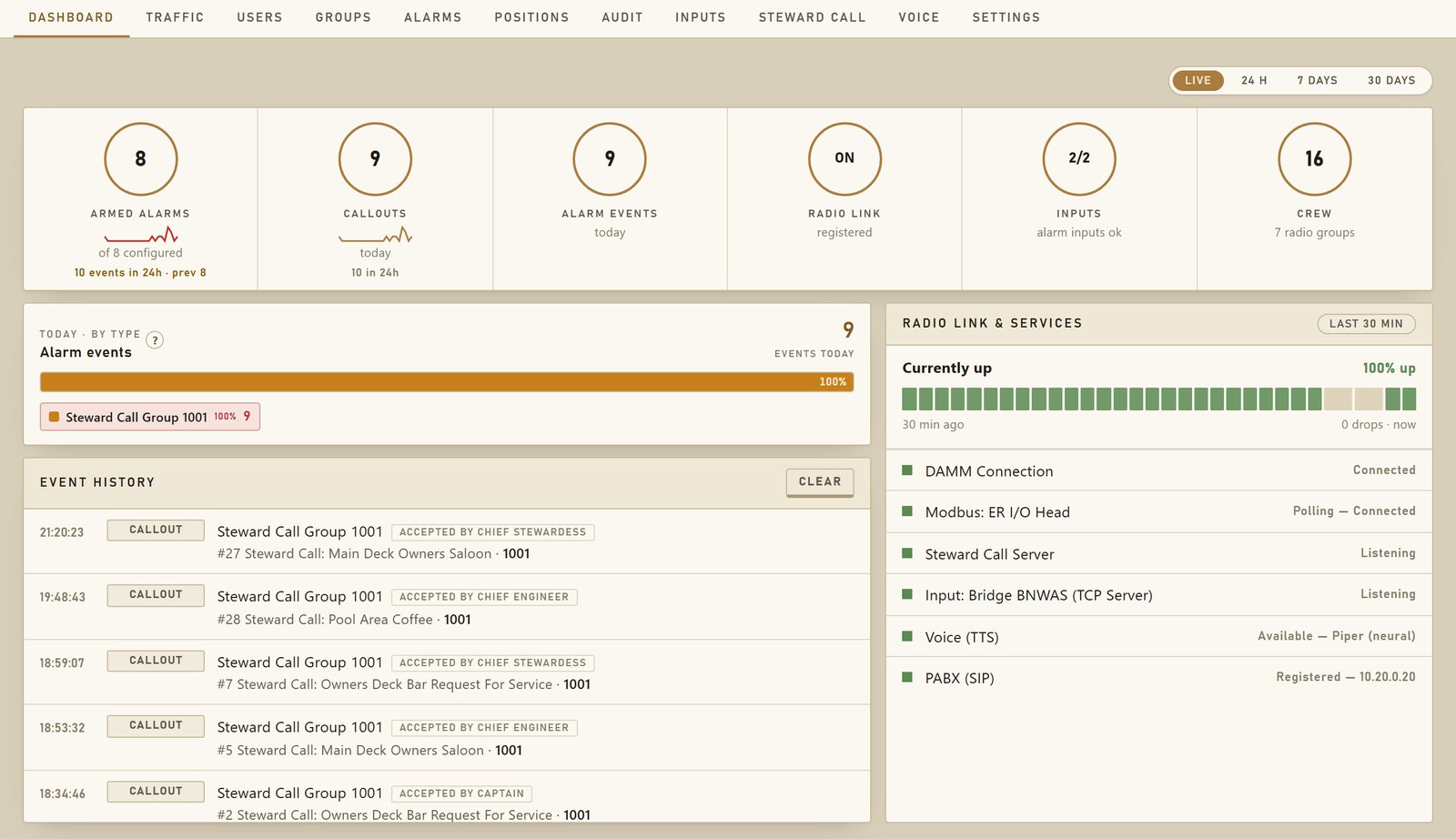
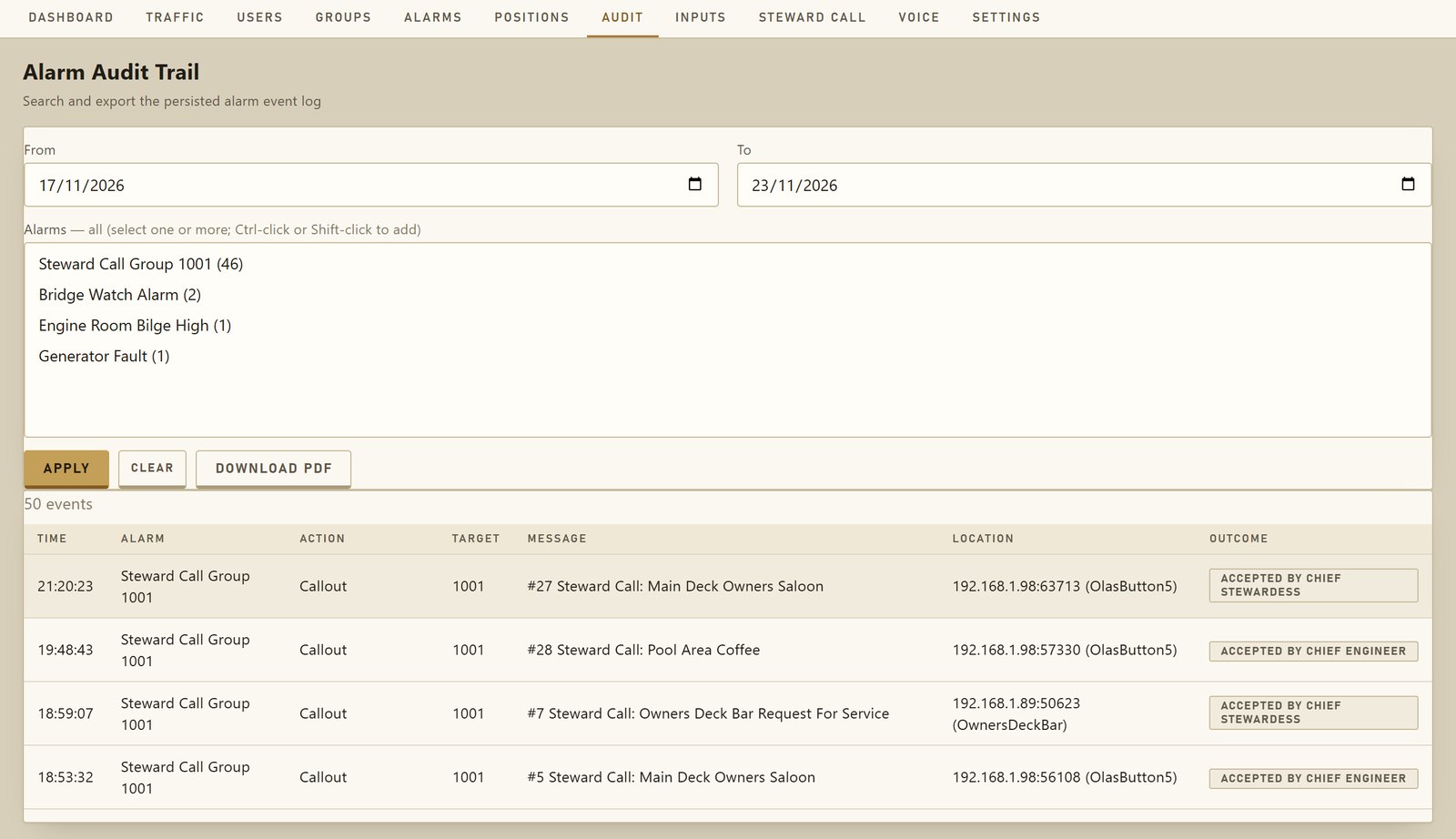
Every alarm, send, escalation, call and acceptance is recorded, and can be viewed and exported from the browser dashboard on the ship's network over HTTPS. Backups are taken automatically, and a wall display shows the ship's alarm state without needing an account.
See It Working
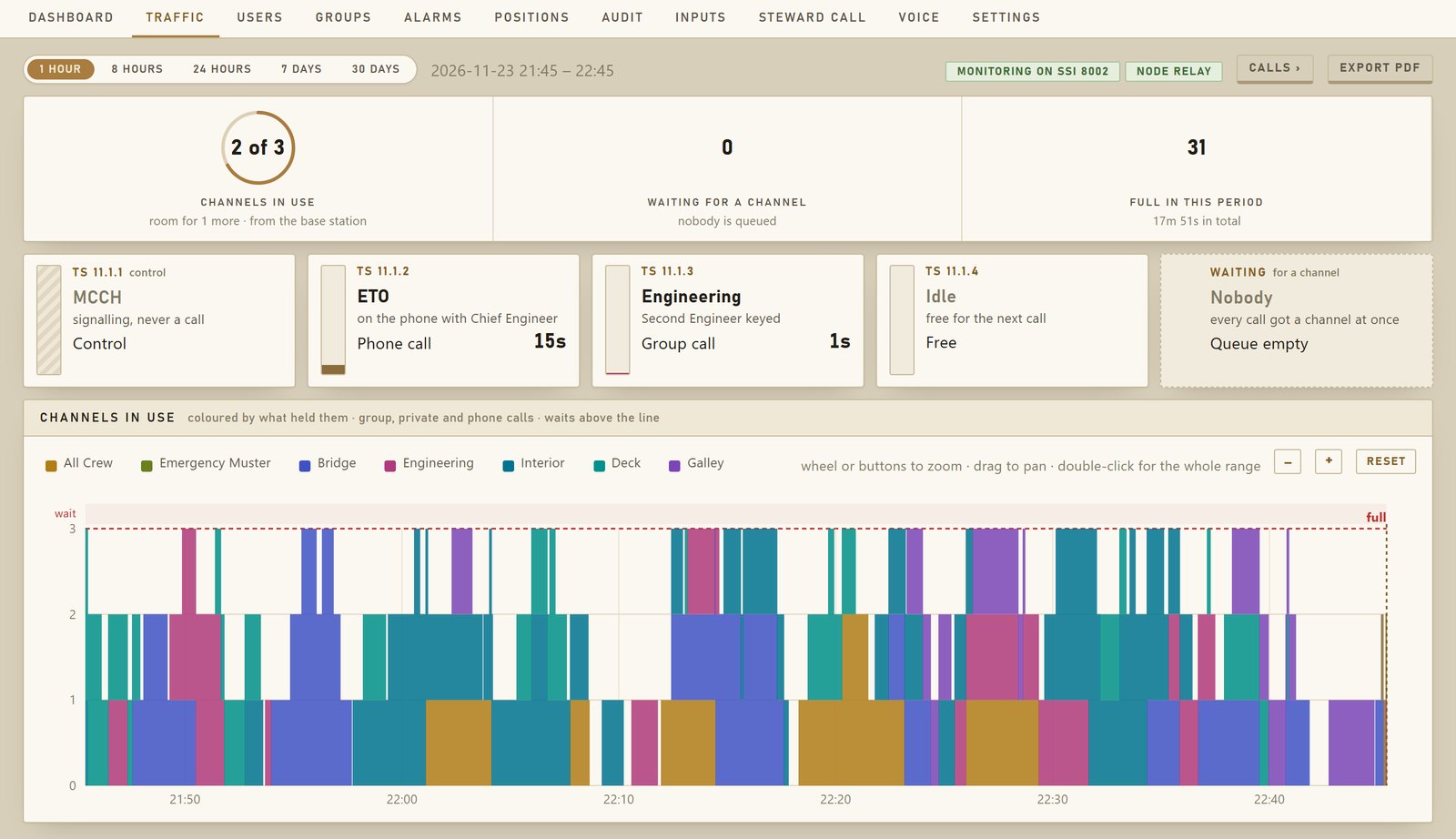
Everything is set up and watched from a browser on the ship's network. These screens are from a demonstration vessel.
TALOS EDGE or TALOS CORE?
Both put the vessel's alarms on the crew's radios and keep going until someone accepts. TALOS EDGE is the lightweight, standalone unit: its own industrial edge controller, so it needs no ship's PC. TALOS CORE runs on a PC on the ship's network and adds everything else — the ship's phones, network text, Modbus, OPC, SNMP and webhook inputs.
| Feature | TALOS EDGE | TALOS CORE |
|---|---|---|
| Alarms to TETRA radios as call-outs the crew accept | ✓ | ✓ |
| Unlimited number of alarms (EDGE suits a small number) | — | ✓ |
| Escalation until someone accepts | ✓ | ✓ |
| Muster call-outs onto an incident talkgroup | ✓ | ✓ |
| Alarms held and sent when the radio link returns | ✓ | ✓ |
| Serial RS-232 and RS-485 inputs | ✓ | ✓ |
| Reading rules on measured values | — | ✓ |
| Wi-Fi crew call buttons | ✓ | ✓ |
| Full alarm record, HTTPS dashboard and backups | ✓ | ✓ |
| Own hardware with contact inputs, CE and UKCA marked | ✓ | — |
| Runs on its own industrial edge controller, no ship's PC needed | ✓ | — |
| Redundancy on a replicating virtual machine cluster | — | ✓ |
| Phone calls and texts through the ship's PABX | — | ✓ |
| Press 1 to accept on any phone, ACCEPT key on desk phones | — | ✓ |
| Network text inputs | — | ✓ |
| Modbus TCP/RTU alarm inputs | — | ✓ |
| OPC UA and OPC DA alarm inputs | — | ✓ |
| SNMP trap input | — | ✓ |
| Webhook input | — | ✓ |
TALOS CORE — common questions
TALOS EDGE is the lightweight, standalone unit for a small number of alarms, on its own DIN-rail industrial edge controller with built-in contact inputs, and needs no ship's PC. TALOS CORE runs on a PC on the ship's network, has no limit on the number of alarms, and adds phone calls and texts through the ship's phone system, plus network text, Modbus TCP/RTU, OPC, SNMP trap and webhook inputs.
There is no limit. TALOS EDGE is built for a limited number of alarms; TALOS CORE handles as many as the vessel's systems raise.
Yes. It connects to the ship's phone system over SIP, rings or texts the phones an alarm names, and accepts on a press of 1 or a dedicated ACCEPT key. An answered call alone is never counted as an acceptance.
A SIP extension in most cases. A trunk is needed only where several phones must ring at the same instant and each person's acceptance must be told apart. We agree this with the ship's IT or phone supplier at installation.
OPC UA and OPC DA servers, SNMP traps, webhooks, Modbus TCP and RTU devices, serial RS-232 and RS-485 lines, network text feeds and Wi-Fi crew call buttons. For a system none of these covers, OLAS builds a bespoke alarm listener.
DAMM TetraFlex. OLAS is the only DAMM Authorised System Partner in the superyacht industry.
Yes. Radios that report their GPS position are shown on a live map with a trail, and their range and bearing from the vessel.
Yes. TALOS CORE can run on a replicating virtual machine cluster, so alarm handling carries on if a host fails.
TALOS CORE runs as a Windows service, so it starts again with the PC and restarts itself after a failure without anyone logging in.
We're here to help.
Talk to one of our specialist team about TALOS CORE alarm handler. Call us, email us, or send a message with the form and we will reply as quickly as possible.
